


Hello! If you’re just starting your journey into the world of Play-to-Earn (P2E) games and have heard terms like “staking” and “farming” but aren’t quite sure how they work or what they offer, don’t worry. This topic may seem complex, but it’s actually very logical. We’ll discuss how you can earn passive income in gaming ecosystems simply by locking your in-game and non-in-game tokens. This is a key mechanic that turns P2E games into not just entertainment, but a potential financial tool.
Staking: Locking Tokens to Support the System
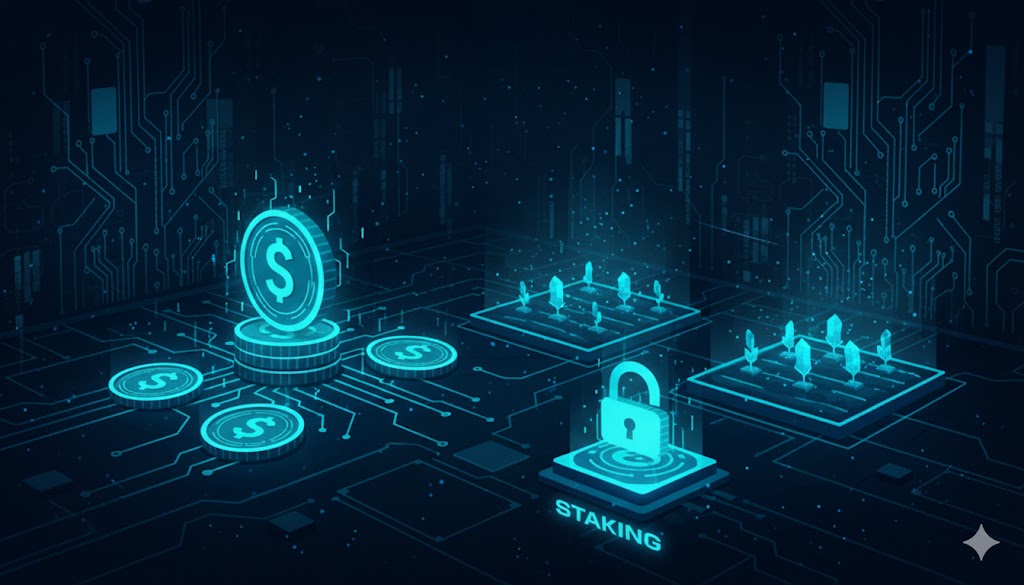
Staking is one of the most common ways to generate passive income in the cryptocurrency world and, accordingly, in P2E games. Essentially, it’s the process of locking a certain amount of your tokens for a specific period. In return for this lock-up, you receive rewards.
How Staking Works
Imagine depositing money in a bank for interest, but instead of a bank, it’s the gaming platform or the blockchain network on which the game is built. When you stake tokens, you’re essentially providing them as collateral to ensure the security, stability, and proper functioning of the network or game protocol.
In the context of P2E games, staking can be implemented in several ways:
- Staking Governance Tokens: Most P2E ecosystems have their own governance token. By locking it, you not only receive rewards but often gain voting rights in decisions about the game’s future development. The more tokens you stake, the greater your voting weight.
- Staking In-Game Assets: In some games, you can stake not only main governance tokens but also other in-game tokens, and sometimes even NFT assets like characters or items. The goal remains the same—locking the asset for a period to earn income.
- Staking for Stabilization: Locking tokens helps reduce their supply on the open market. This promotes stability and long-term token value, benefiting all ecosystem participants.
Staking Rewards
Staking rewards are typically paid in the same tokens you’ve locked or in other ecosystem tokens. The reward amount depends on several factors:
- Lock-Up Period: Longer lock-up periods often offer higher annual percentage yields (APY). This encourages long-term participation.
- Total Staked Amount: If a lot of tokens are already staked, your share in the pool is smaller, and thus the yield may be lower.
- Protocol Rules: Each game has its own unique reward accrual rules. Rewards may be distributed daily, weekly, or at the end of the lock-up period.

Yield Farming: Providing Liquidity
Yield farming, or simply farming, is a more complex but potentially more profitable way to earn passive income. At its core, farming involves providing liquidity to decentralized exchanges or pools within the gaming ecosystem.
Liquidity and Liquidity Pools
For users to easily and quickly exchange one token for another within the gaming platform without intermediaries, liquidity pools are needed. A liquidity pool is a large digital reservoir containing pairs of different tokens. For example, a pool might hold the game token and a stablecoin.
When farming, you become a liquidity provider-you add an equal value amount of both tokens from the pair to the pool. For instance, if you want to provide liquidity to a pool of game tokens and stablecoins, you might deposit $100 worth of game tokens and $100 worth of stablecoins.
In return, you receive special liquidity provider (LP) tokens. These confirm your share in the pool.
How to Earn from Farming
Passive income in farming comes from two main sources:
- Swap Fees: Every time another user swaps tokens through the pool, a portion of their fee is automatically distributed among all liquidity providers proportional to their pool share. This is your first and steady income source.
- Farming Rewards: To incentivize liquidity provision, platforms offer additional rewards. You take your LP tokens (received for depositing into the pool) and stake them in a special contract—this is the farming process itself. In return, you receive rewards in additional tokens, often the governance or main game token.
Farming Differences and Risks
The key difference between farming and staking is that farming always involves providing two different tokens, not one.
Farming carries a specific risk called impermanent loss. This arises from changes in the price ratio between the two tokens in the pool.
Suppose you deposit tokens A and B. If token A’s price surges relative to B, the pool’s automated system will sell some A for B to maintain value balance. When you withdraw, you might find the total value of your tokens is less than if you’d simply held them in your wallet without providing liquidity. However, swap fees and farming rewards usually outweigh this impermanent loss, making farming profitable long-term.
Staking and Farming in Gaming Ecosystems
In P2E games, these mechanisms aren’t just earning methods-they’re vital for economic balance and system sustainability.
Tokens in Gaming Ecosystems
Most P2E games use a dual-token model:
- Utility Token: Typically used for everyday in-game actions like buying items, upgrading characters, or victory payouts. This token is often inflationary, with its supply constantly increasing.
- Governance Token: More valuable, used for staking, governance, and as the key asset reflecting the game’s overall value. It often has a deflationary nature or limited supply.
Staking governance tokens and farming involving both types are primary tools for value redistribution and user motivation.

Benefits for Players
For players, staking and farming open the door to passive income without constant gameplay:
- Steady Income Stream: You keep earning while tokens are locked, even when sleeping or offline.
- Governance Participation: Staking gives a sense of involvement and influence over your favorite game’s development.
- Asset Accumulation: Reward tokens can be reinvested-back into staking or farming-to compound earnings over time.
Benefits for the Game
For the platform, these mechanics are critical for economic health:
- Reduced Selling Pressure: More tokens locked in staking or farming means fewer available for immediate market sales, helping prevent sharp price drops.
- Capital Attraction: Farming draws significant capital into liquidity pools, enabling easy asset swaps for players and investors.
- Long-Term Outlook: Long lock-up mechanisms encourage sustained investment and reduce short-term speculators.
Integration into the P2E Process
Staking and farming aren’t separate from the game-they extend it and monetize achievements.
Using In-Game Rewards
When you complete quests, win battles, or farm resources in a P2E game, you earn utility tokens. Instead of selling them immediately, direct them to staking or farming:
- Path to Staking: Swap earned utility tokens for governance tokens and stake them.
- Path to Farming: Swap half your utility tokens for stablecoins or governance tokens, then pair them for liquidity and start farming.
Thus, gameplay becomes an active capital source that transforms into passive income via staking and farming, creating a self-sustaining economic cycle.
Importance of Studying Terms
Before starting staking or farming, carefully review the platform’s terms:
- APY: Check expected annual percentage yield. High rates often mean higher risks.
- Lock-Up Periods: Learn minimum lock times and early withdrawal penalties.
- Platform Security: Ensure the platform has a solid reputation and independent security audits.
Comparison and Mechanism Selection
For newbies, choosing between staking and farming boils down to risk and complexity assessment.
Staking: Simplicity and Stability
Staking is generally simpler and less risky for beginners.
- Simplicity: Deals with one token type-no liquidity pair worries.
- Risk: Mainly token price drops. No impermanent loss like in farming.
- Verdict: Ideal if you believe in a governance token’s long-term potential and want to hold and grow it simply.
Farming: Higher Yields and Complexity
Farming can offer higher returns but demands deeper understanding and impermanent loss risk.
- Complexity: Involves two tokens, LP token receipt, and staking them.
- Risk: Token price drops plus impermanent loss. Requires more active management.
- Verdict: Suited if you’re willing to take more risk for potentially higher yields and swap fee income.
Both staking and farming are powerful passive income tools in P2E games. Understanding their essence, benefits, and risks enables informed decisions and optimal use of earned tokens. Start with simpler staking to get comfortable, then move to farming as you gain confidence in the game economy.
Exploring these opens your path from mere player to active participant and beneficiary of the evolving gaming economy. Remember, in P2E games, your assets work for you even when you’re offline.