



2026 could become a turning point for the Web3 gaming industry. While the market in 2021–2023 was driven by NFT hype and Play-to-Earn mechanics, the sector is now entering a stage of maturity: players demand quality, investors expect sustainable economies, and developers need real scalability tools.
Let’s explore the key changes ahead.
1. From Play-to-Earn to Play-and-Own
The “earn tokens and sell them” model is gradually fading. Players are tired of projects where gameplay exists purely for farming rewards.
In 2026, the focus shifts to Play-and-Own — playing for enjoyment first, with asset ownership as added value rather than the core incentive.
This means:
- fewer hyperinflationary tokens
- stronger emphasis on game design
- in-game economies balanced like traditional AAA titles
Blockchain games will increasingly compete with Web2 games in quality — not just profitability.
2. Deeper Integration with Major Ecosystems
By 2026, blockchain games will no longer feel like a separate universe. They will integrate more deeply with ecosystems such as Ethereum, Solana, and Immutable.
This will bring:
- lower transaction costs
- faster onboarding
- wallet abstraction (players may not even realize they’re using blockchain)
Users will log in via email or social accounts rather than managing complex seed phrases.
3. NFTs Will Become “Invisible”
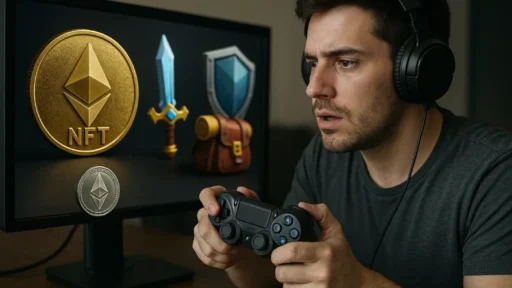
In 2021, NFTs were marketed as the core product. In 2026, NFTs will be embedded infrastructure rather than a headline feature.
They will:
- verify ownership of items
- unlock access to tournaments
- enable cross-game assets
But players won’t need to think about NFTs — for them, it’s simply a skin, character, or weapon.
4. More Sophisticated In-Game Economies
Developers are becoming far more serious about tokenomics. The collapse of many early P2E projects proved that without inflation control, game economies eventually fail.
In 2026, we’ll see:
- dynamic token-burning mechanisms
- withdrawal limits
- well-designed sink mechanics
- in-game DAOs managing economic decisions
Games will be built as long-term digital worlds rather than short-term speculative schemes.
5. Hybrid Web2 + Web3 Models
Many studios will adopt hybrid approaches:
the game is accessible to everyone, while blockchain features remain optional.
Players will be able to:
- play for free
- avoid connecting a wallet
- purchase NFTs only if they choose
This significantly lowers entry barriers and expands the audience beyond crypto-native users.
6. Increased Regulation
Regulators will pay closer attention to tokenized gaming models, especially in the U.S. and the EU.
Projects will need to:
- carefully structure token models
- avoid securities classifications
- strengthen AML procedures
Compliance will become part of the game development process.
7. Greater Focus on Community and Long-Term Value
By 2026, the winners won’t be the projects that raised the most money — but those that retained players, built strong communities, and created emotional engagement.
Players will choose worlds that offer:
- narrative depth
- culture
- social interaction
Conclusion
Blockchain games in 2026 will become less speculative and more mature.
Technology will move into the background, while the spotlight shifts to:
- gameplay quality
- sustainable economies
- seamless user experience
- meaningful digital ownership
If early Web3 games sold the promise of earnings, the next generation must sell the joy of playing.
And that will determine who survives in the market by the end of 2026.