

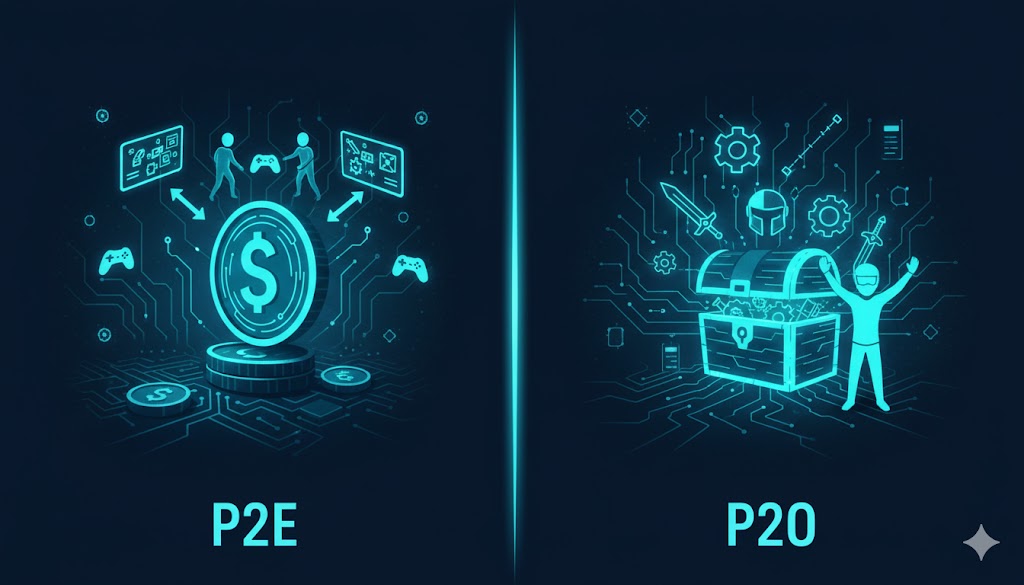
The sphere uniting video games and blockchain technology is in constant development. New approaches to player interaction with virtual worlds are emerging within it. Two key models defining this landscape are Play-to-Earn (P2E) and Play-and-Own (P2O). Although both models utilize non-fungible tokens (NFTs) and cryptocurrencies, they have fundamentally different priorities and mechanisms that influence the player experience and the long-term stability of gaming ecosystems.
What is P2E
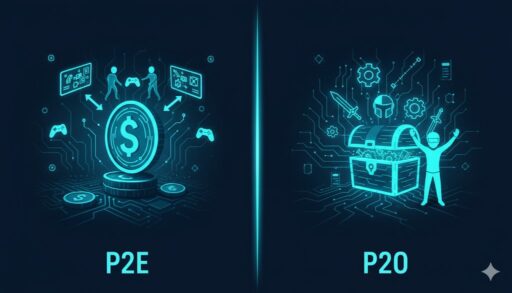
The Play-to-Earn model primarily focuses on the opportunity to earn real value through gaming activity. In this paradigm, rewards-often in the form of in-game cryptocurrencies or NFTs-become the main incentive for participation. P2E gameplay is frequently built around repetitive tasks or “resource farming” required to obtain these rewards. The value of in-game assets is closely linked to their potential for sale or exchange on external markets, making economic motivation the primary driver for most players.
What is P2O
Play-and-Own (P2O) represents a more recent evolution that shifts the emphasis from earning to asset ownership and gameplay quality. In P2O, players still own their NFT characters, items, and land, but this ownership is intended to enhance and deepen the gaming experience itself, rather than solely extracting profit. The core motivation in P2O is enjoyment from playing, with asset ownership complementing this by providing control, governance rights, and uniqueness.
Differences in Priorities and Design

Primary Player Incentive
In P2E, the main incentive is financial gain. Players enter the game to earn tokens or NFTs that can be monetized. This can make the gameplay secondary to economic efficiency, with players opting for the most profitable actions, even if they aren’t the most engaging.
In P2O, the primary incentive is enjoyment and a unique experience. NFT ownership unlocks additional gameplay opportunities, such as new content access, customization, or governance participation. Earnings, if present, are a byproduct of engagement and success in the game world, not the main goal.
Impact on Game Design
P2E game design often centers on creating a steady reward flow to attract and retain grinder players. This can lead to complex and sometimes opaque economic mechanisms that require a constant influx of new users to sustain token value. In P2E, the economy dominates gameplay.
P2O game design, conversely, prioritizes gameplay quality. Developers aim to craft an immersive, polished world where blockchain enhances the experience rather than being its sole purpose. NFTs and tokens serve as tools to expand player capabilities, not pure financial assets.
Role of Asset Ownership
In P2E, NFTs are often viewed as income-generating tools. For example, an NFT character might enable earning in-game currency. Ownership is inextricably linked to earning potential. Players may acquire NFTs purely for financial returns without intending deep immersion.
In P2O, NFTs symbolize ownership rights over elements that enhance the gaming experience. This could be a unique cosmetic item, a plot of virtual land granting special event access, or a governance token for voting on game decisions. Ownership adds emotional value and a sense of belonging.
Economic Sustainability and Long-Term Outlook
P2E Economic Sustainability
P2E economies often face sustainability issues. When earning incentives drop due to token price declines or NFT market saturation, many grinder players exit. This creates a vicious cycle: player outflow further depresses demand and token prices. Many P2E games rely on continuous new investments to pay rewards to early players.
P2O Economic Sustainability
The P2O model offers greater sustainability potential, as its foundation is the value of gameplay itself. Players continue engaging even without immediate financial upside because they enjoy the game. NFT value in P2O depends more on in-game utility and community desirability than pure speculation. P2O economies align better with traditional successful video game models, where engagement drives longevity.
Players and Community
Player Types in P2E
P2E attracts a broader user spectrum, including those with low gaming interest but high earning motivation. “Guilds” or “farms” often emerge, optimizing earnings via multiple accounts or automation. This can shift the social dynamic from competition and collaboration to pure economic activity.
Player Types in P2O
P2O primarily draws traditional gamers who value content quality, gameplay depth, and social interaction. The community fosters long-term relationships and contributions to the virtual world, as ownership instills a sense of stake in the project. This builds a more stable, engaged user base.
Governance and Decentralization
Both models incorporate decentralization, but for different ends. In P2E, it ensures transparency and security for financial transactions and assets. In P2O, decentralization empowers player-owners with real governance via Decentralized Autonomous Organizations (DAOs). NFT or token holders vote on updates, gameplay changes, or fund allocation, enhancing ownership and accountability.
Impact on Investment Appeal
Investments in P2E Assets
P2E asset investments are often speculative. NFTs and tokens surge during hype but plummet when the economic model falters or interest wanes. Investors focus on yield potential and tokenomics over creative or code quality. Risks are high due to reliance on user base growth.
Investments in P2O Assets
P2O investments tie more closely to long-term project evaluation as entertainment products. NFT value stems from in-game utility and demand from actual players. Investors assess dev team, gameplay, graphics, and innovation. These projects aim for slower, sustainable growth rooted in genuine community.
Interaction with Game Mechanics
Game Loops in P2E
P2E loops are often simple and repetitive, optimized for earning efficiency. Players perform token/NFT-generating actions for extraction and monetization. This can devolve into monotonous work lacking fun. Developers must sustain demand for new NFTs/tokens to keep the system afloat.
Game Loops in P2O
P2O employs complex, varied loops akin to successful traditional games. NFTs integrate into deeper progression, customization, or social systems. For instance, owning land might enable unique builds attracting players or hosting mini-games. Retention relies on evolving, compelling content.
Barrier to Entry for Newcomers
Barrier to Entry in P2E
Early P2E games had high entry barriers requiring expensive starter NFTs for earning. While easing via rentals or free kits, initial motivation tied to financial investment. Newbies also face hurdles grasping complex economics and risks.
Dak Barrier to Entry in P2O
P2O projects offer accessible entry, often free or low-cost like traditional free-to-play games. NFTs are optional enhancements acquired later. Gameplay focus makes them appealing and intuitive for newcomers seeking fun over work.
Summary for Newbies
Key Takeaways
Newbies should grasp that P2E and P2O differ in core purpose. P2E treats games as earning mechanisms where finance dominates. P2O views games as joy sources where ownership deepens immersion, ownership, and influence. For potential earnings, study P2E aware of economic risks. For quality entertainment with ownership perks, choose P2O. P2E success metric: token price. P2O: returning players for fun. Pick what aligns with your goals.
Challenges and Future
P2E Challenges
P2E’s core challenge is economic balance. High rewards inflate tokens; low ones cause exodus. Maintaining equilibrium demands constant tweaks. Gameplay quality often sacrifices to economics, alienating traditional gamers.
P2O Challenges
P2O’s main hurdle is crafting truly quality games. If unengaging, no ownership tech saves it. High-quality development takes more time/resources than early P2E. Blockchain must enhance, not complicate, mass-user experience.
Convergence Prospects
Over time, convergence is likely. Games blending deep gameplay, true ownership, and earnings as engagement byproducts will thrive. Priorities remain: P2E on earning, P2O on play/ownership. Understanding these helps newbies choose wisely in crypto gaming. Remember: ownership ≠ automatic earnings; earnings ≠ guaranteed fun.